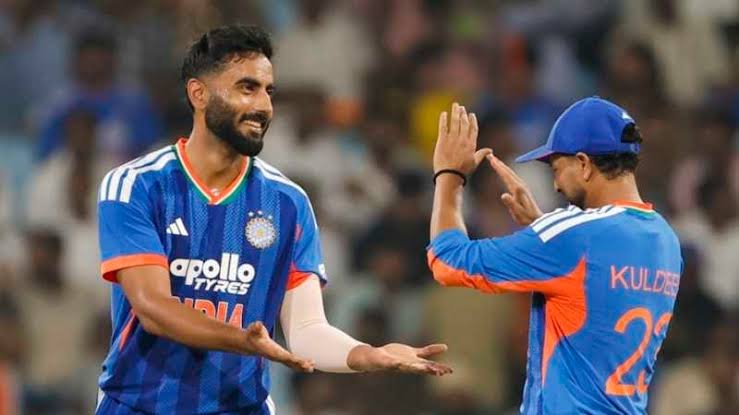
Aakash Chopra, a cricket specialist, has commented on the selection dispute, highlighting Shivam Dube’s continued absence from the team and Naman Dhir’s retention. Chopra’s perspective underlines the tension between acknowledging current success and allowing experienced players to rejoin the club.
According to Aakash Chopra, resting Dhir is not a good idea given his present form with the bat. According to the former India opener, Shivam Dube should replace Nitish Kumar Reddy in the starting lineup, not Dhir.
The fourth Twenty20 International between India and New Zealand will be played on October 30 at Eden Park in Auckland, with Shreyas Iyer leading the blue team. India has already won the series after three consecutive victories, so the focus is now on selection strategy and the performance of middle-order batters competing for a few spots in the starting lineup.
Throughout the series, Dhir has batted regularly. In the first Twenty20 International, he struck 42 not out from 15 deliveries; in the second, he hit 31 from 17 balls. India’s success has been primarily due to his aggressive attitude, and Aakash Chopra’s evaluation of Dhir’s bowling ability reinforces the case for keeping him. Despite only bowling one over in the first three games, the 26-year-old’s batting performance alone warrants his selection in the starting lineup.
Why should Shivam Dube be chosen?
Dube, 33, has not appeared in any of the three Twenty20 Internationals played so far. The experienced batsman has been benched as India prefers Nitish Kumar Reddy and Naman Dhir in the middle order. As recently as July 2026, Dube was playing ODIs for India in England. His performances in the ICC T20 World Cups in 2024 and 2026 highlight the depth of experience he brings to the team.
Aakash Chopra’s stance indicates a separate hierarchy of selection criteria.
Also Read : England Sign Off Tri-Series with Consolation Victory Over Sri Lanka
Dube should replace Reddy in the starting lineup rather than Dhir, whose current performance does not justify a bench berth. The selection dispute emphasized the competitive nature of India’s middle order, with multiple players vying for opportunities in the T20I format.